
A travelog
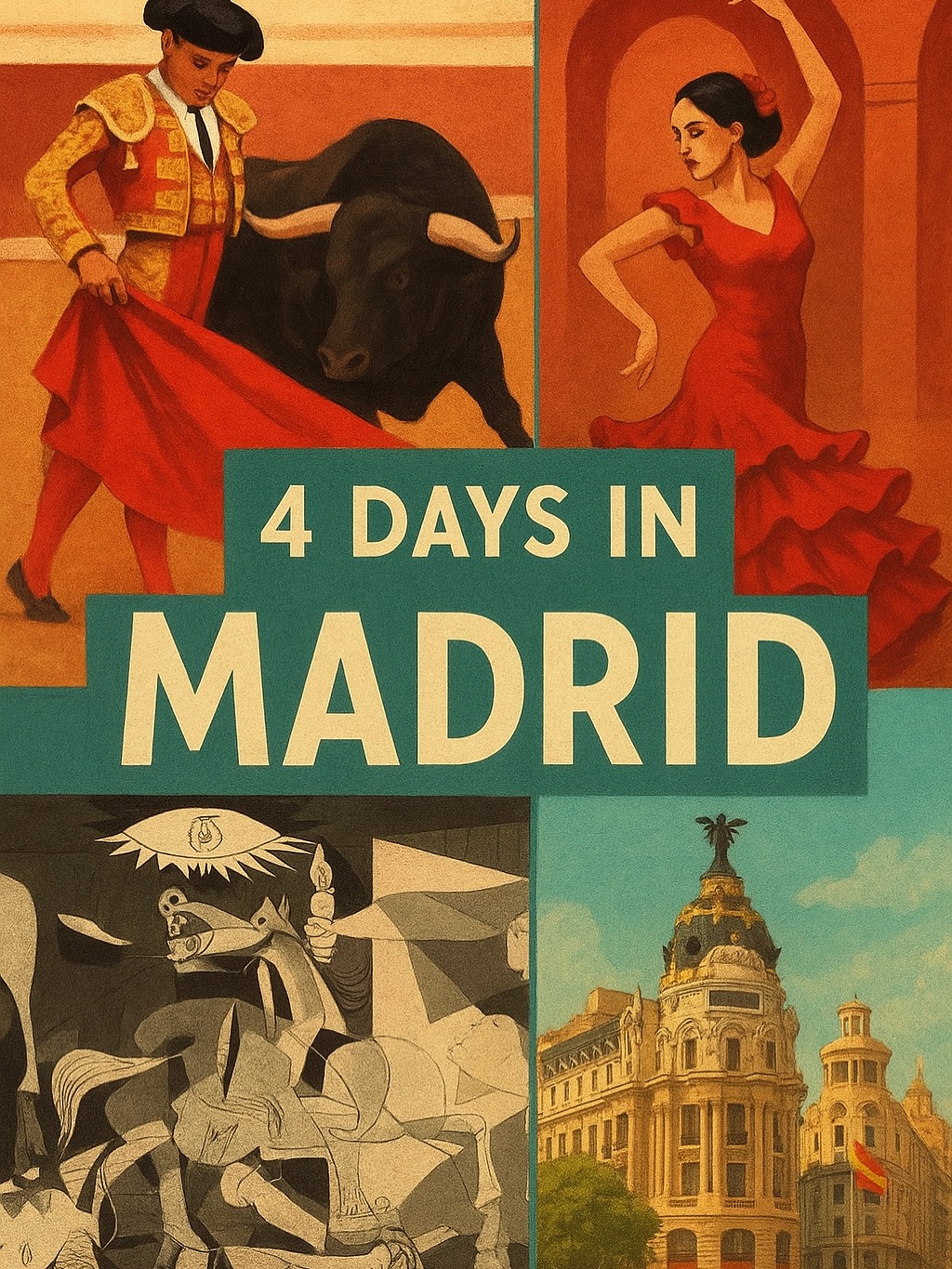
Saturday
The end of September, summer drawing to a close, a British Airways COVID voucher burning a hole in my pocket, and so to Madrid – home of Lorca, Picasso, Modric, Franco, Hemingway, Bellingham, Iglesias, the Prado, an Egyptian temple, flamenco, tapas, teeming streets, ceramic tiles, bullfights, El Cordobés, jamon, Irish bars and (probably) the largest Primark in Western Europe.
The flight uneventful and we sailed through passport control, stamped as foreigners, and walked for miles to find the metro. Eventually made it to Puerto de Sol – the main square in Madrid and 50 metres from the apartment – after accosting Spaniards who spoke little English – the cheek of it – and met our lady with the key and Google Translate on her phone, who, in all of 15 seconds, showed us round.
An apartment right in the thick of it, between two Irish bars, the 6th floor, in the attic, ceilings as tall as Danny de Vito, no TV, two ring hob, a broken shower, small windows looking onto terracotta tiled roofs, but just enough space to sleep, defecate (just), dump our bags, boil a kettle and charge our phones.
We headed out into the heaving Saturday evening streets, through the Plaza Mayor to the Mercado San Miguel – a glass and iron covered market thronged with food stalls and people.
Heaped plates of jamon, every kind of shellfish, thousands of olives, melons like basketballs, delicate cakes, clinking glasses of white wine, cakes and pastries oozing cream, packed tables, narrow walkways, guzzling locals guzzling local delicacies.
Jamon (ham) appeared to be Madrid’s chief culinary fame and gift to the world. Carved in bible thin slices from a leg clamped to a wooden board, dark red, almost maroon, aged for hundred of years, slippery and veined with fat – if reincarnation is a thing, try not to return as a pig in Spain, unless you are a fan of acorns and happy to gift your leg or legs to hungry locals and curious gastronomic foreigners, and then spend the rest of your porky short life in a wheelchair.
And along Gran Via – intended destination for the final stage of the Vuelta, cancelled due to protests – lined with shops and heaving with Saturday evening browsers, shoppers, shoplifters and beggars. I realised I’d forgotten to bring a belt so was worried of ending up like a New York rapper, trousers bisecting my buttocks so needed to find a shop. We spotted a Primark the size of a Latin American dictator’s palace – endless escalators, infinite rooms, cavernous halls of cheaper than chips piled pants, shirts, jumpers, skirts, thousands of people pushing, shoving, browsing, piling hunks of clothes into their trolleys like refugees heading for the border. We traipsed through the groaning temples to Mammon before finding a belt – lovingly hand-made, woven leather, delicate filigree details, handmade tooled Moorish and ancient Spanish craftsmanship – 9 euros and made in China.
And then on to the Temple de Debod, dismantled during the construction of the Aswan Dam and transported, massive unmortared block by block to a park, there re-built by the Spanish in gratitude for lending support.
Inside, carved pictures in relief on the stone, 2200 years old, dark echoing chambers, nervy guards, and outside, young and old sitting on the grass, watching the sunset, bopping to buskers, cuddling and canoodling, living life on the street.
Back past the statue of Don Quixote, skinny as a cyclist, with chunky Sancho Panza at his side, sitting plump on his mule and finally, footsore and hungry, an outside table at a restaurant Alhambra, a plate of roasted aubergine, courgette, asparagus, giant tomato, onion and then ribs and chicken and chips, the chicken soft and tender and juicy, the chips crisp and hot and salty, the ribs bloody and gristly, fatty, charred, resisting chewing.
And so to bed – a mattress hard as a villain, no give and no mercy, tired but sleepless, tossing and turning, rolling like a marble on a plank, trying and failing to get comfy. Up in the night for a wee, bent double like a miner, creeping along to the toilet, only able to stand over the pan by slotting between two roof beams.
Sunday
A walk to art and the Civil War. We grabbed our guide book and map and headed out through quiet streets, sidewalk restaurant tables packed away, bins overflowing with party animals, the day cloudy but warm, humid, dampness in the air.
The Reina Sofia Museum, arriving at 10, a small queue formed, tickets bought online and headed straight to Picasso’s magisterial Guernica. Big as a wall, black and white and grey, no splashes of colour, to mimic the newspaper reports, broken bodies, contorted faces, dive bombing destruction frozen in time. A barrier in front, ranks of people already there, phones at the ready to snap their own version of this masterpiece. We stood with them – they took photos of the painting; I took photos of them taking photos.
Art can often be admired, respected, absorbed, appreciated, understood, consumed – but seldom does a picture speak to you across the years as this one does. Perhaps partly due to Picasso’s distorted vision, it doesn’t date, doesn’t age, doesn’t lose its chance to shock and remind. Arranged around the walls are preliminary pen and ink sketches of faces, heads, scenes, swift deft strokes that later coalesce into great art.
We lingered longer in other rooms – Salvador Dali, Magritte and others – and then went in search of coffee.
‘Sit here,’ said a waitress, pointing at a table.
We sat and then another waitress appeared and scowled at us and removed all the plates and cutlery, annoyed that we didn’t want lunch. Coffee was perfunctory but the chairs soft and the room peaceful and we were grateful for a rest.
El Retiro park was next on our list – a big, green sprawling park like Central Park or Hyde Park. Wooden booths lined the wide boulevard – second hand booksellers one after another, groaning tables in front, browsers picking through dusty tomes.
All human life was in the park – joggers, cyclists, roller skaters, babies in buggies, wheelchairs, buskers, beggars, people exercising and pumping iron, push ups and pull ups and planks, ice cream sellers and ice cream eaters, show offs and readers and writers and journal keepers, row boaters, strollers and promenaders and runners, lovers hand in hand, kissing or arguing on benches.
Before leaving the UK, we’d booked a tour of Las Ventas – the Madrid bullring – as well as tickets for the fight. The walk to Las Ventas was long, along wide boulevards, this was Spanish town, few tourists ventured here on foot, the bullring big and round, built of brick and stone, round like the Colosseum, tiered like a wedding cake, outside hawkers and touts, water, crisp, cushion, banner and souvenir sellers, setting their stall as if preparing for a football match.
We collected our hand held guided tour and entered for a fascinating wander, almost alone in the hallowed space. The bullfight not due to start for a few hours, so the bars still shuttered, cleaners cleaning, quiet and waiting for action. The walls had paintings and memories of the great fighters as mentioned by Hemingway – Joselito, Juan Belmonte, Manolete – colourful, glittering suits of light, dark, swarthy intense gazes, fierce eyes, set expressions,
We entered the bullring through a tunnel, dark and red , breaking into the light, circular, sandy, wooden barriers, the concrete seats rising up in steep rows, open to the sun and higher, roofed and shaded for the wealthier patrons.
The sun beat down on the deserted bleachers, the picador horses stabled, awaiting their starring role in later events. As we wandered, audio guide held to our ear, the disembodied voice explained the history of the bullring, the great fighters, the program and process and outcome of the fight, the rituals and rules and traditions, the balletic moves and pirouettes, the sparkling multi coloured skin-tight costumes, the elaborate hats, the spectacle and tragedy, the risks and injuries and death – always of the bull, occasionally of the matador.
We loved it.
We hadn’t eaten or drunk all day and found a nearby restaurant – decidedly Spanish, no tourists (except for us), a life size bull at the entrance, stuffed bulls heads and bullfight posters on the walls, grizzled, gored greying ex fighters sitting at tables, quaffing and guzzling, regaling their womenfolk with tales of great encounters, crowded together, hot, stuffy, steamy, beside us an old man, small but wiry, bloodshot eyes, sharp nose and strong fingers, fishbones littering his plate and moustache, a glass of beer close at hand.
‘English menu?’ said the waiter, as we struggled with the unfamiliar language. He brought it and we studied it. My partner looked around at our fellow diners, chomping and licking their lips.
‘I fancy what they’re having,’ she said.
The waiter came back.
‘What are they having?’ She said, pointing at a big family across the aisle.
‘That’s a different menu.’
‘We want that menu,’ she said. The waiter brought us a menu with a set selection on it – 3 courses plus a drink and coffee.
My friend ordered fish soup and bull’s head, asparagus and steak for me.
I’d recognised the Spanish for asparagus but missed the other ingredients – a thin white linguini like brains, and mussels or cockles or whelks – some briny mollusc that couldn’t swim faster than the net anyway – small, chewy, fishy, rubbery, each one pale and dead or dying between my closing teeth.
The steak, pink with flecks of blood, the surface charred from a hot griddle, chips golden and salty. My friend’s fish soup, tomatoy and spicy with nature’s watery bounty dancing in its smoky depths and the bull’s head, slow-cooked for hours, the meat slipping off the pale skull, deep and soft and dark.
We devoured the bread and olives and then lingered over ice cream and coffee as the restaurant slowly emptied, leaving us and the vacant stuffed bull’s heads which gazed down at us, reproachful and bitter.
The bullring – Las Ventas filled slowly. We rented cushions on the way in and an usher showed us to our hard stone seats. It’s like a wedding cake in 4 tiers and we were in the second highest tier – shaded from the sun or any rain that may fall, the roof over us like icing, a panoramic view of the ring and the action. The base of the ring is made of sand 1.5 metres deep and was bone dry. A man stood in the centre wielding a long hose and carefully and painstakingly damped down every square inch of sand – we watched as for the next 45 minutes the sand changed from parched beige and silver to a darker shade.
The bullring slowly filled up as people shuffled in – men, women, old and young including some couples with very young children, although it was by no means full when the action started. A nut brown, thin, sun damaged middle aged lady sat a few seats along and lit a pungent cigar – its acrid aroma wafting over us until we could stand it no more and shifted our seats.
At 6pm precisely, a trumpet sounded, the President stepped into the ring, raised his hand and the festivities began. All the protagonists (except the bull) entered the ring – the three matadors in their shiny suits, the bandilleros following, picadors on their horses swaddled in protective blankets, the helpers and assistants, the mules in their harnesses that would later drag the dead bull away. They all paraded around, receiving the cheers and applause of the crowd, before all except the three matadors exited to be followed by a small team who ran out with buckets and shovels and swept up the manure which the horses and mules (but not the matadors) had left in little piles on the sand. The matadors waited – behatted, holding their billowing red capes.
There was an expectant silence for a brief moment before a red wooden gate opened and a bull rushed into the ring, like a ram raider or shoplifter in a china shop, stopped in the centre, testicles the size of grapefruit swinging slowly in their sack, raised its heavy horned head, sniffed the air, spotted the crowd leering down at it and then charged the nearest matador, its heavy hooves thundering over the impacted sand. The matador brandished his cape as the bull neared and then slipped behind the barrier as the bull slammed into it. The bull paused momentarily, unsure of what had just happened, before it caught a glimpse of another swaying cape and turned and raced towards the next matador.
This process continued for a while – the bull charging, the matadors waving their capes and then slipping behind the barrier, the bull’s horns slamming into the fence, the sound of splintering wood echoing around the ring, until a gate opened and a picador entered, elaborate beige costume, behatted, tall lance held upright, one hand gripping the bridle, the horse caparisoned in heavy padding, a black blindfold covering its eyes. The bull paused in its battering and turned slowly like an umpire following a tennis rally, observing the motionless horse, enclosed in a chalked area according to strict rules – allowed no further than a white line.
The picador pulled on the bridle and the horse turned slowly presenting its protected side to the bull, which lowered its head, pawed at the ground and then charged – 550 kilos of thundering hard muscle, flying hooves, sharp horns, heavy black head, swaying testicles, slamming into the horse’s covered flank. The horse was pushed back but held its ground, the picador rising in his stirrups, swinging the lance under his arm like a medieval knight and then driving the sharp point between the bulls shoulders and into its neck.
This tableau remained for some minutes – the bull with its head locked against the horse’s flanks, trying to get under the padding, the horse standing silent and bored, waiting, like a bored wife waiting for her husband to finish his amateurish lovemaking, the picador risen in his stirrups, lance thrust down and sticking in the bull’s neck, the matador’s assistants dancing around like under-employed waiters, waving their capes and trying to distract the bull from its unfinished task.
Eventually, the bull grew bored and tired and perhaps realising that it wouldn’t be able to sink its horns into the horse, never mind the matador, backed away to re-group, and the picador exited through the gate, and the bull stood solid but bloodied, blood oozing from the wound in its neck.
The next act of this grizzly spectacle then began.
Two bandilleros came dancing into the ring like clowns at a circus performance, brightly and colourfully dressed and each one holding two barbed sticks each about a metre long. They had no capes, nothing to distract the bull, relying on guts and bravery, fleet feet and quick reactions and a little tricorn hat. They teased and taunted the bull and as it ran at them danced to one side and stuck their barbed sticks into its back. The barbs pierced the flesh and stuck there and as the bull charged around, the swaying sticks gouged further chunks into its flesh, so that rivulets of blood flowed down its sides. Their 4 sticks embedded and their work done, and the bull weakened and wearied, bloodied but still unbowed, the bandilleros left the arena for the matadors and the bull to begin their final performance, the last act of this sandy, bleeding ballet, the matador to entertain and hopefully survive, the bull to play its part in entertaining the crowd and then end up dead.
The bull was tired, weakened, teased, threatened, disorientated, bleeding and in pain but the show must go on. It did the only thing it could do, the only thing it knew how to do, the only thing left to do. The matador stood upright, haughty, regal, bright sharp staring eyes, slim, muscled, one hand on his hip, the other shaking the red cape until the bull spotted it, ducked its head, pawed at the ground leaving drag marks in the sand, gathered its strength and the last vestiges of its will and charged.
This was (supposedly) what we had come all this way and paid all this money to see – the balletic, cultural, age defying grace of the matador controlling, directing, dominating, reducing the bull to a mere plaything, tiring it, overpowering it, before delivering the final coup de grace.
Over and over the bull charged in ever decreasing circles, brought up short by the cape, horns missing the shiny suit by inches, turning in smaller circles like a London taxi on Oxford street, the matador at times, nose in the air, chin pointed upwards, hand on his hip, back to the bull, daring it to catch him.
With the bull nearing exhaustion, the matador walked to the barrier, there to be handed the killing sword, long and thin and deadly, a small hilt and hid it within the cape. On its final pass, exhausted, half blinded, blood streaming from its flanks, the matador sank the blade between its shoulders.
Our matador, perhaps having an off night, perhaps second on the bill, perhaps tired, did not drive the sword in to the hilt but only part way, so the bull instead of being killed cleanly, stood, unsteady, dying, beaten, before sinking to its knees and expiring in the sand. As soon as it fell, the gates opened, helpers ran in, tied ropes to its horns and then the mules arrived, the ropes attached to their harness and they ran out of the ring, dragging the noble dead animal across the sand and out of the ring, as the crowd cheered and clapped.
We neither cheered nor clapped.
There were 3 matadors and each one was scheduled to kill 2 bulls. We watched each of the three and saw three bulls die. One could say that if you’ve seen one bullfight you’ve seen them all as the process, the ritual, the various acts of the play follow a set pattern and strict rules. What distinguishes one from another therefore, is the skill and performance of the matador and the slight, but still real, possibility of serious injury or death of the fighter. (The serious injury and death of the bull is, however, an inevitability).
We made our way down the concrete steps and out into the darkening sky and walked back the 6 miles to our apartment. We walked in silence for a while, lost in our own thoughts and trying to make sense of what we had just experienced. Many people will be offended, shocked, horrified or disgusted that we should have even thought of attending a fight, let alone actually sat through one and seen three bulls die. And I can understand those feelings. However, I had a number of reasons for wanting to go:
- I’d always enjoyed reading Hemingway and he had a noted interest in the bullfight and had written about it numerous times
- I thought I should experience the bullfight before forming an opinion on it
- It’s a Spanish cultural tradition and deserved respect
- Live sporting occasions are always fascinating and exciting
Having experienced it, my thoughts are:
- I loved it and was fascinated by the tradition, the ritual, the history, the pageantry and the colour
- The matadors we saw were not of the highest quality or were having off days
- The torture of the bull was unpleasant
- The slow, lingering, painful death of a noble animal was sad and shocking to see
- I would go again but only if the matadors were the best and most skilled of their generation
We were tired when we got back – 13 miles on hard pavements had done for our feet. We were hungry too. I fancied a traditional jamon roll so we stopped at one of the many jamon bars/shops/cafes and purchased two to take away. Back at our Lilliputian home we tucked in, although tucked in suggests a more pleasant experience than it actually was. Purchasing at the end of the day meant that the roll had probably sat there for a day if not longer, and was tooth breakingly hard like ship’s hard tack – too calcified for even the weevils to break in. And the much lauded jamon was tired, stringy, sweaty, curled like month old newspaper with no more taste, and sans butter, if I did manage to gnaw off a hunk like a practiced beaver – it stuck to the roof of my mouth. So, I had some chocolate instead.
Monday
We’d brought 2 guide books with us – Lonely Planet and Top Ten – and found some walks we wanted to do. But first we needed breakfast. The day before I’d gone out early to take some photos and had gone to a cafe and bought a couple of croissants to take back to our tiny hutch of a flat to have with a mug of tea.
Today we headed out early into the bright sunshine to follow a walk through the Lavapies district. Being Monday, many shops and cafes were closed. We walked the quiet backstreets as bin lorries chased us along, old ladies walked to the shops, the quiet city woke up to face the day. Street names in the old city were engraved on ceramic tiles with a colourful drawing to illustrate the name and I started a photo project to document them. As we walked along I stopped at every sign – usually high up on the wall – to take a picture, using Hipstamatic, my favourite photo app.
Many cafes were closed but the guide book mentioned one – zzzzz – which luckily for us was open. It was an old fashioned, old cafe, with cracked mirrors on the walls, faded posters, marble tabletops – quiet, peaceful, a couple of customers sipping coffee, a single bearded white sprinted barista serving behind the long zinc counter.
There was a set breakfast and we ordered coffee, orange juice and a ham and cheese croissant and sat and ate, gazing round at the tired but atmospheric interior.
Before leaving the UK we’d booked a flamenco night – how could we not experience this authentic, genuine, tourist experience? There were many venues advertising flamenco nights, usually with the same photo of a swirling stamping lady in red. We reached our venue – elaborate, colourful tiles, paintings and photos of what was in store for us, queues of tourists waiting for entry. Our ticket entitled us to one free drink – I toyed with a gin and tonic, Jim Beam, a spiced rum, a screwdriver or mallet or pint of pliers, a Cointreau or 30 year old single malt – but it transpired the bartender had 2 jugs, one of some concoction with alcohol and one without. It was ok.
We were led in to the venue – a small stage surrounded on three sides by tables and chairs, the chairs packed together like a popular church funeral. We had booked seats at the front, a few feet from the stage. The room filled up but like the bullfight was by no means full when the action started – maybe the cruise ship crowd were missing.
6 men in black walked out and sat at the back of the stage – 2 guitarists, a sax and flute player, a very tall percussionist who sat with a tea chest between his legs, and 2 others sans instruments but revealed themselves shortly as singers.
The lights dimmed, the guitarists began to pick and strum, the flautist flauted, the big percussionist commenced a rhythmic thwack and bang and tap on his wooden box, and the singers or chanters commenced a wail – maybe with words which we couldn’t understand but more a sound, a feeling, an incantation as the dancers – two women and one man stepped up to the stage. The women had very tight dresses which flowed into long swirling, dervish trains which they had to step over and around and lift with one hand as they performed. The man was swarthy with slicked black hair and a little ponytail and as the dance progressed, grew faster and more furious, sweat flying, hands clapping, heels and toes tapping and stomping – his hairband removed and the rat tail like strands swished around, flying beads of sweat almost hitting our table, as we sat transfixed and entranced.
First the three danced together, then all three left the stage, before one lady returned for a solo performance which they each did.
We loved it. We’d expected a perfunctory, desultory, bored performance, repeated endlessly 3 times a night for drunken hen parties and elderly couples who no longer talk to each other, but the three dancers were superb – skilful, engaged, incredibly strong and energetic, with lightning fast legs and shaking stamping banging feet, twirling hands, they put on a magnificent show and the black clad musicians provided amazing musical support.
At the end of the all too brief performance – we could have happily watched much more – they left to well-deserved and rapturous applause. As we left, I saw the male dancer standing at the bar, much smaller than he had seemed on stage and went and tapped him on the arm – ‘bravo’ I said. And he deserved it, as they all did.
We left the flamenco show, ears still ringing from the stamping feet and the incantations of the two singers, the tea chest bangs of the percussionist and headed out into the night.
We were looking for La Venencia, a bar frequented by Hemingway and popular in the civil war. We wandered down dark alleyways, ghostly light emerging from restaurants, a warm night, following Google maps and stumbled across it, a plain dark wood entrance, clinking glasses and conversation spilling out onto the street, a dark sign above the door.
A haunt of spies during the war, the bar had maintained its traditions and rules – it only sold sherry or water and photography was forbidden. It was a place for assignations, for secret affairs, for lovers to meet, spies to share secrets, deals to be done, stories to be invented and shared, false rumours to be started, notes to be passed, Madrid intelligentsia to meet and greet and cheat.
We went in – a narrow space, the long bar on one side, bartenders dispensing sherry, a few tables, crowded, the hum of conversation, lovers hands entwined, more space at the rear. I looked around, soaking up the atmosphere, peeling wallpaper, smoke stains, hooded lights, sherry drinkers. Neither of us were sherry drinkers so we didn’t stay but it was a fascinating place, rich in history and memories.
Tuesday
Our flight left in the early evening, so we packed our bags and left our tiny apartment and deposited our bags in a locker facility. The day was overcast and cool and we walked through quiet back streets taking photos of street signs. We followed a walk from the guide book, my friend reading aloud from the descriptions and pointing out the historic sights we passed and soon reached the Circulo de Belles Artes which the guide book said had a roof terrace with fine views over the city.
It opened at 10 and we were the first to arrive. We rode the ekevator to the 7th floor and emerged onto the open terrace. The sky was grey and it was windy – a cleaning lady slowly mopped the floor. The bar area, stools, tables and red loungers, busy and buzzing at night with the clink of glasses and exciting conversations were deserted and damp. The views over the city, though extensive, were dulled and monochrome, and a slight mist still hung over everything like a shroud. The haughty statue of Minerva towered over us, dark and silhouetted against the dreary sky. We pulled our jackets closer until it was time to descend.
We continued our walk heading for the Prado. Madrid’s most famous art gallery was a behemoth of a building – grand and forbidding, a temple to art and culture, but we’d done our art with Guernica and Dali and decided to give this a miss and missed its many glories.
Walking on and a stroke of luck we stumbled on the botanic garden which was free this morning! We wandered through the greenhouses, moving through the desert, sub-tropical and tropical environments, cacti and lianas trailing around our heads.
Our trip was nearly over. We headed back to Puerto del Sol dropping into a couple of churches on the way. They were elaborate, baroque, over the top Catholic shrines, overflowing with statues, effigies, candles, weeping saints and overwrought virgins, dripping with gold and ornaments, crucifixes, stained glass, acres of candles, heaving caskets of relics, all the panoply of popery. It seemed to me that the Catholics were trying a bit too hard to convince themselves of God’s existence by protesting a bit TOO much. If God exists – and who am I to know? – does he really need all this proof that us lowly mortals believe? Could he not be happy with the occasional cross and one painting of Jesus and not desire 500 weeping and wailing epiphanied and flagellated saints, pockmarked by arrows and torture? The churches were either populated by quiet Catholics sitting in pews and praying, confessing their sins with public displays of penitence, or tourists (like us) wandering around in practiced awe, ticking another sight off the guide book list, and recording ill composed and snatched snaps on their phones.
We were tired after 40 miles of walking in 3 and a bit days.
We retrieved our cases and searched for ice cream. My partner had promised me ice cream and we’d seen a number of parlours. We stopped at an Italian gelato and gorged on the flavours – chocolate and cherry and blueberry before making our way to the metro. We were experts now – fluent in Spanish, lonely planeted experts, seasoned travellers, intrepid explorers and navigated the system back to the airport with practiced ease.
We fell on the Burger King and stuffed ourselves with burgers and fries and coke – back to civilisation at last.
 lanternerougeblog